Process Temperature Maintenance via Electric Heat Tracing: An Engineering Imperative Across Multiple Industries
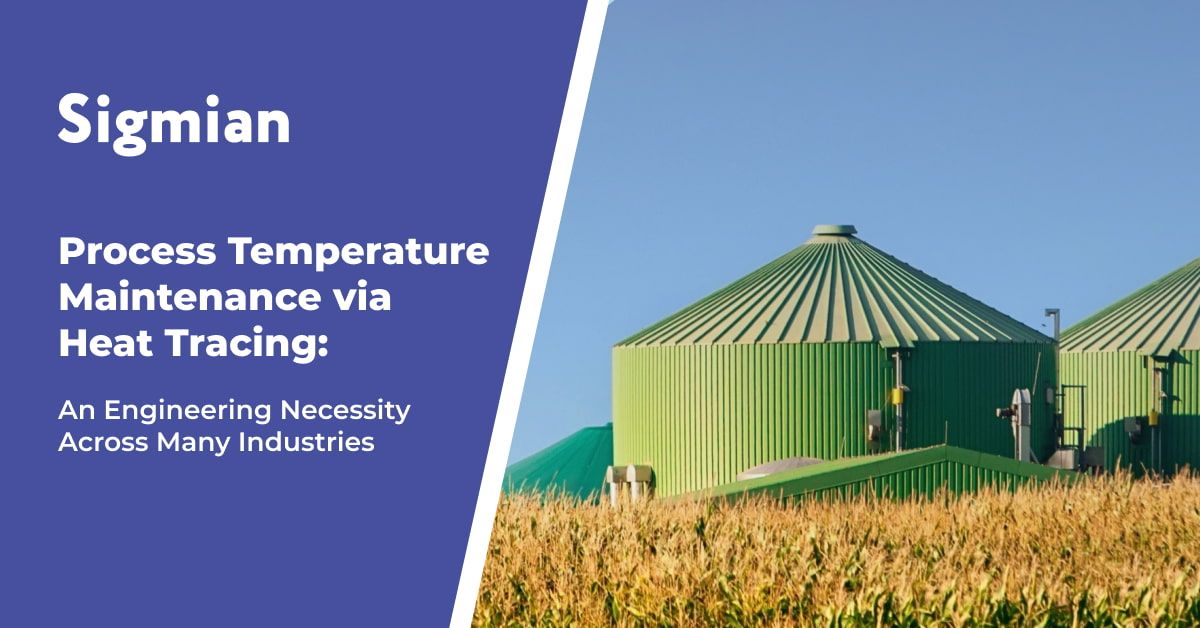
Beyond hydrocarbon processing — a technical examination of heat tracing applications in food, pharmaceutical, chemical, and bioenergy sectors.
When engineers encounter the term "heat tracing," the immediate association is frequently the oil and gas sector. This is unsurprising, given the industry's longstanding reliance on electric heat tracing for flow assurance, viscosity management, and freeze protection. However, process temperature maintenance (PTM) employing electric heat tracing constitutes an equally critical engineering discipline across a diverse range of industrial domains where temperature directly governs product quality, energy efficiency, and regulatory compliance.
This article examines four sectors in which PTM via electric heat tracing is not merely advisable but constitutes an engineering necessity.
1. Food and Beverage Production
Thermal Sensitivity of Hydrocolloids and Lipids
Foodstuffs such as chocolate, honey, syrups, vegetable oils, and molasses exhibit pronounced temperature-dependent rheological behaviour. A decrement of only a few degrees Celsius can induce crystallization, phase separation, or solidification — phenomena that precipitate line blockages, product wastage, and protracted cleaning-in-place (CIP) cycles.
Engineering Rationale for Heat Tracing:
Precise, distributed thermal control along transfer lines, storage tank outlets, and filling manifolds is requisite to maintain product consistency within specified rheological parameters. Hygienic system architectures, compatible with high-pressure wash-down protocols and food-contact material regulations, ensure that the thermal solution does not compromise sanitary conditions. Self-regulating heating cables, characterized by their positive temperature coefficient (PTC) behaviour, are frequently specified for their capacity to modulate local heat output autonomously, thereby mitigating the risk of overheating and caramelization.
2. Pharmaceutical and Biotech Manufacturing
Thermal Stability of Biological and Chemical Compounds
Active pharmaceutical ingredients (APIs), water for injection (WFI), buffer solutions, and fermentation media demand strict temperature windows to preserve molecular stability and prevent solute precipitation. Deviations from specified thermal envelopes can compromise batch integrity and constitute violations of current Good Manufacturing Practice (cGMP) standards.
Engineering Rationale for Heat Tracing:
Validated, fully traceable systems with comprehensive documentation are mandatory for regulatory compliance. ATEX-certified configurations are available for solvent-handling areas where flammable atmospheres may be present. Uniform thermal maintenance, characterized by the absence of localized hot spots, ensures that sensitive biological and chemical moieties remain stable throughout processing, transfer, and storage.
3. Specialty Chemicals and Polymers
Viscosity-Temperature Coupling and Its Implications
Numerous chemical intermediates and polymer melts exhibit a strong temperature-dependent viscosity profile. A thermal reduction of only 5–10°C can double or triple dynamic viscosity, with direct consequences for pump performance, mixing efficiency, and reaction kinetics. This nonlinear relationship renders precise thermal control critical to process performance and product consistency.
Engineering Rationale for Heat Tracing:
Systems must be dimensioned for thermal recovery, not merely steady-state maintenance — cold starts impose power requirements three to five times greater than steady-state heat loss calculations suggest. Thermal bridges at pipe supports, flanges, and instrumentation penetrations must be meticulously quantified to avoid localized cold zones that can increase heat loss by 300–500 percent relative to fully insulated sections.
4. Bioenergy and Biogas Facilities
Rheological Challenges in Organic Feedstock Handling
Feedstock lines, digestate transfer pipes, and glycerin handling systems are susceptible to clogging at reduced temperatures. In cold climates, unheated lines precipitate production stoppages with significant economic consequences.
Engineering Rationale for Heat Tracing:
Reliable freeze protection ensures continuous operation throughout winter months. Energy-efficient operation, remote monitoring capability, and ATEX compliance for potentially explosive atmospheres (methane-rich biogas environments) are all critical design parameters. Properly engineered systems maintain consistent feedstock rheology and prevent costly downtime.
Common Engineering Deficiencies Across All Four Industries
Despite the critical nature of heat tracing in these applications, engineers consistently encounter recurring design gaps:
· Transient thermal events are systematically excluded. Systems are sized exclusively for steady-state heat loss, with no provision for cold-start recovery requirements. This omission results in inadequate heat-up capacity during process upsets, unplanned shutdowns, and unexpected ambient temperature excursions, thereby extending downtime and increasing restart complexity.
· Thermal bridges are routinely omitted from calculations. Pipe supports, flanges, and instrument connections constitute preferential heat loss pathways that are frequently neglected in thermal analysis. These localized cold zones can increase total heat loss by 300 to 500 percent relative to fully insulated sections, with consequent temperature non-uniformity that undermines flow assurance and compromises system performance.
· Insulation assumptions are unrealistic. Idealized properties — dry, new, and perfectly installed — are specified rather than realistic parameters that account for aging, mechanical compression, and moisture ingress. This practice systematically underestimates actual heat loss under service conditions and leads to undersized systems incapable of meeting operational thermal demands.
· Control strategy is inadequate. Single-point temperature measurement is employed rather than representative thermal gradient mapping across the system. The coldest point on a process line is frequently located at a support, a valve, or a section exposed to wind, which a single sensor cannot reliably detect. Consequently, control decisions are based on incomplete thermal data, resulting in suboptimal system performance.
Engineering Best Practices for Robust PTM Systems
To ensure reliable performance across all these applications, engineers should adopt a comprehensive design methodology incorporating the following principles:
· Design for worst-case ambient conditions. Calculations should be based on minimum temperature, wind chill, and low solar gain — rather than annual averages — to ensure adequate thermal capacity under the most demanding operational scenarios.
· Specify maximum allowable heat-up duration. This parameter, defined from cold-soak condition, should be established as a performance requirement, ensuring that adequate recovery power is incorporated into the system design to achieve operating temperature within acceptable timeframes.
· Validate sensor placement against actual thermal gradients. Temperature sensor locations should be verified against empirical thermal gradient profiles across the system, with sensors positioned at the coldest identified segments of the process line to ensure representative control inputs.
· Employ certified equipment for hazardous areas. ATEX, IECEx, or equivalent certification should be utilized for hazardous zone applications to ensure intrinsic safety and regulatory compliance.
When these principles are systematically applied, PTM serves as a robust enabler of flow assurance, consistent product quality, and long-term operational reliability — transcending the limitations of a purely steady-state approach.
Conclusion
Process temperature maintenance via electric heat tracing is not a secondary utility — it constitutes a fundamental engineering discipline with direct implications for product quality, process availability, and regulatory compliance. Irrespective of the application domain — whether food processing, pharmaceutical manufacturing, chemical production, or bioenergy generation — properly engineered heat tracing systems ensure that temperature-sensitive processes operate reliably and within prescribed specification limits.
Sigmian designs and manufactures electric heat tracing systems engineered for actual operating conditions, not nominal calculations, with ATEX certification for hazardous area applications. The company's solutions are grounded in process-driven engineering principles, ensuring that critical processes remain within specification regardless of ambient conditions. Through rigorous design methodology, comprehensive thermal analysis, and adherence to international certification standards, Sigmian delivers heat tracing solutions that meet the demanding requirements of modern industrial processing